Today’s post is devoted to the the second pillar of food ethics identified last time — how to minimize food waste. In my observation, we Americans waste a lot of food. This is especially true for those who have never known want and therefore tend not to see waste as a problem.
Although I have wasted an embarrassing amount of food in my life, in recent years minimizing waste finally has become a priority. Working toward that goal fosters good karma, inspires culinary creativity, and saves money all at the same time. Not a bad deal!
My basic strategy for avoiding waste is as follows:
(1) plan carefully;
(2) use vegetable scraps and carcasses to make homemade stock;
(3) share with friends; and
(4) learn how to make risotto and frittate because they accommodate a wide variety of ingredients, including leftovers.
The Importance of Planning
There are many ways to plan so that you match what you buy to what you use. If you have a hectic schedule or must drive 20 miles to the nearest market, then the once-a-week shopping outing might be best for you. That involves thinking ahead about what you’ll eat during the week and acquiring everything you’ll need on one designated shopping day. If you have easy access to markets and desire more day-to-day flexibility, then maybe the European “shop-as-you-go” model is preferable. It’s just what it sounds like — wake up, decide what you want to eat today, and go to the market to procure only what you need for that. Or, you could join a community supported agriculture (CSA) program, build a menu plan around what you receive each week, and supplement as needed or desired with trips to the market. The key is to be honest with yourself about what is most realistic for you, keeping in mind that your optimal strategy might well change over time.
Save Vegetable Scraps and Carcasses for Stock
One easy and rewarding practice is to save vegetable scraps, chicken carcasses, and other animal bones and use them to make stock. You’re eventually going to throw all these things away uneaten, but you can extract tons of flavor from them before you do and thereby ensure that they did not die in vain.
“Won’t I then have too much stock and end up wasting that?,” you might ask? Nope. Stock freezes beautifully, and once you realize its many possibilities you will use it regularly. Making soup and risotto are obvious uses, but you also can use stock instead of water to cook beans, rice, and braises, which greatly enhances their flavor.
I save the tops, bottoms, and peels of carrots, celery, potatoes, and onions, as well as parsley stems, in the freezer in the same gallon-size resealable bag. When I get a critical mass, I make stock. It’s also good to save, each in their own separate bag, the trimmings of mushrooms, tomatoes, and garlic. Those don’t go into the mixed bag because their flavors aren’t always desirable, depending on what you plan to do with the stock, but if you save them separately then you’ll have them handy when you need them.
When I roast a whole chicken, my new habit is to break up the carcass and throw it into the stock pot, either with frozen vegetable scraps or with rough-chopped onion, carrot, celery, a couple bay leaves (those stay whole), a handful of peppercorns, and some thyme. I feel guilty that I haven’t been doing this all along, because I roast a lot of chickens, but better late than never. The same can be done with other chicken or meat bones that find their way into your kitchen.
The basic lesson here is, before you throw something out, ask yourself whether it has a place in the stockpot. If it does, save and use it accordingly! See my “Soup Season!” post for tips on how to make vegetable stock (scroll down to the end). Meat-based stock works exactly the same way, just with bones added.
Share!
When I mentioned the idea for this post to my friend Karen, she noted that sharing food with others was one of her favorite waste-avoidance strategies. Thank you, Karen, I agree this is a wonderful idea! Maybe you are good at taking restaurant leftovers home and actually eating them, but in spite of my best intentions they tend to turn scary colors in my refrigerator before I eventually throw them out. Sharing at a restaurant, especially one that has gargantuan portions, therefore is a very good option for me. Similarly, if you don’t know what you’re going to do with all those apples that keep showing up in your CSA box, why not invite some friends over for homemade applesauce or apple crisp? Sharing, whether at home or while dining out, is definitely karmically preferable to, and more fun than, throwing away perfectly good ingredients!
The Seemingly Infinite Possibilities of Risotto and Frittate
My final tip for avoiding waste is to convince you to learn how to make risotto and frittate, because once you master the basic technique these are dishes into which you can put almost anything.
Each of these dishes is great when you have raw ingredients, especially if you have too much of something or you have something you’re not quite sure how to use. For example, if you find yourself awash in squash during the summer, there’s nothing quite like a frittata with sautéed zucchini, caramelized onions, and mint (thanks to Italian friend Loredana for the tip about the mint). Similarly, I knew nothing about cooking kohlrabi when one arrived in my CSA box, but was saved by a wonderful Martha Rose Shulman recipe for kohlrabi risotto that used both the bulb and the greens. Absolutely delicious.
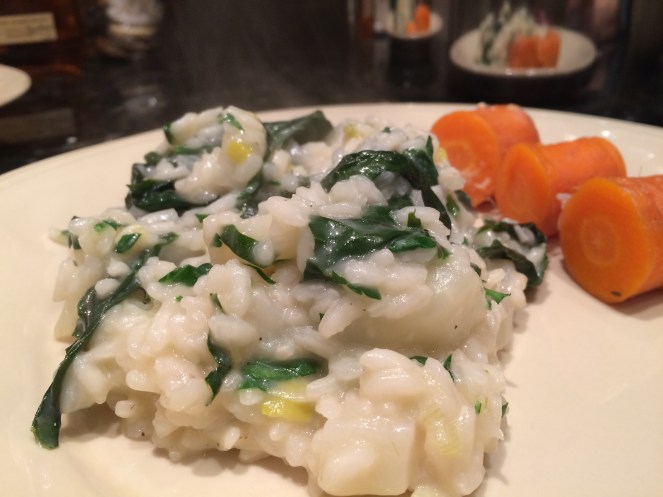
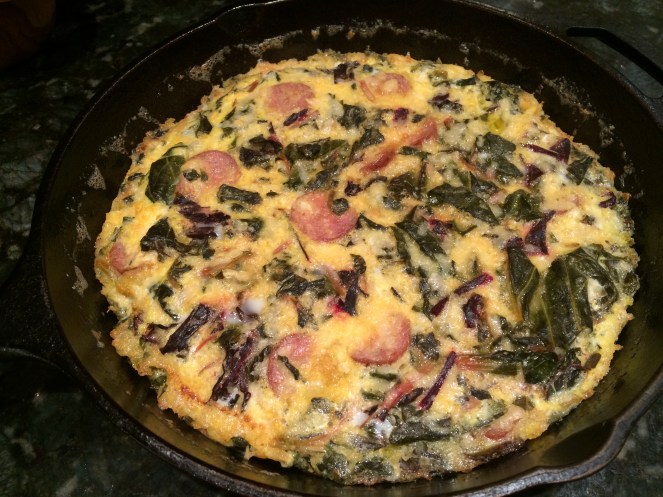
Risotto and frittate also are fabulous conduits for leftovers. Maybe you simply reheat your leftovers, which is perfectly fine. If, however, you have a more creative bent, then using them in a risotto or frittata might be more fun for you. Last week I had a leftover sausage and some leftover mixed greens, which I promptly transformed into a very tasty frittata. My husband, whose opinion on food usually must be clawed out of him, spontaneously said, “Wow, this frittata is really good!”
One of the principles on which this blog is built is that there’s rarely any one way to cook a certain dish, and frittate and risotto certainly are not exceptions. All the comprehensive cookbooks (e.g., Joy of Cooking, How to Cook Everything, Fannie Farmer) have instructions for these dishes, as of course do cookbooks devoted solely to Italian food (those of you have read previous posts know that I love Marcella Hazan’s Essentials of Classic Italian Cooking). All these recipes are similar but different, so I encourage you to peruse these and other sources to find the recipe that strikes you as best. Or, better yet, read everything and then come up with your own take on a classic! In the meantime, I’ve set forth below my preferred approach for each dish.
Risotto Recipe (with vegan option)
Use oil instead of butter for sautéing and omit the butter and Parmigiano-Reggiano at the end to make this vegan.
Once you add the rice, you will need to stir almost constantly, although taking a brief break now and then is fine as long as the rice doesn’t start to stick to the pan.
Ingredients
- 2 tablespoons butter or olive oil
- 1 small onion, chopped finely
- 1 to 2 cups raw or previously cooked vegetables (if using leftovers, take them out of the refrigerator about 30 minutes in advance to let them come up to room temperature)
- 1.5 cups arborio rice
- Salt and pepper
- 1/2 cup white wine
- 7 or 8 cups stock, heated
- 2 tablespoons softened butter (optional)
- 1/2 cup grated Parmigiano-Reggiano (optional)
Instructions
- Place 2 tablespoons olive oil or butter in a medium saucepan or large skillet and turn the heat to medium. Saute onions, stirring occasionally, until they are translucent and light gold.
- Add the other vegetables. If raw, sauté until they start to turn tender; if leftover, sauté briefly until heated through.
- Add the arborio rice and stir, making sure to evenly coat the rice with the oil and vegetable mixture.
- Add a small amount of salt and pepper; then add the wine and let it most of it cook off, stirring as needed so the rice doesn’t stick to the pan.
- Ladle in 1/2 cup to 1 cup of the heated stock and stir almost constantly until the liquid is absorbed. Repeat this step as many times as needed until the rice is tender but retains a slightly firm interior. Start checking the rice for doneness after about 20 minutes, but it could take up to 30 minutes.
- As soon as the rice is done, stir in the softened butter and Parmigiano-Reggiano, adjust the salt and pepper if necessary, and serve immediately.
Frittata Recipe
Frittate are great for using leftovers because they include cooked vegetables and/or meats. You certainly can start with raw ingredients and cook them immediately before inclusion, but if you already have cooked foods handy then this becomes the easiest weeknight supper ever.
There are two ways to cook a frittata. The traditional method is to cook it on the stove on relatively low heat until it is almost totally set and then run it quickly under the broiler to set, but not brown, the top. The other is to cook it in a 350 degree oven the whole time. I prefer the second method for its ease (and because I am scared of the broiler), so that is the method I explain below.
Ingredients
- 2 tablespoons butter
- 5 to 8 eggs, depending on the size of the eggs, the size of your pan, and the quantity of other ingredients you plan to include. This is a judgment call, and you’ll get the hang of it as you practice. If in doubt, start with 6 eggs for a 10-inch pan. Set the eggs out 30 minutes before you plan to cook them.
- 1 to 2 cups solids, which can be raw or cooked vegetables or cooked meat. If using refrigerated leftovers, set those out 30 minutes before you plan to use them, too.
- 1/2 cup Parmigiano-Reggiano
Instructions
- Preheat the oven to 350 degrees for at least 30 minutes, and remove the eggs and any other refrigerated ingredients you’ll be using at that time. If using raw vegetables or meat, cook them while the oven preheats, and allow them to cool a bit before mixing them with the eggs.
- Melt 2 tablespoons of butter in a 10-inch cast iron pan (preferred) over low heat, or place 2 tablespoons melted butter in an ovenproof, nonstick round dish of similar size.
- While the butter melts, crack the eggs into a large mixing bow and scramble them with a fork until the yolks and whites are mixed, but do not beat them too vigorously.
- Stir the vegetables and/or meat and the P-R into the eggs.
- Make sure the melted butter coats the bottom and a fair portion of the sides of the pan, and add the egg/vegetable/meat mixture to the pan.
- Place the pan in the oven and cook until the eggs are set firmly but gently throughout, about 12 to 15 minutes, but do not let the frittata brown on top.
- Remove the pan from the oven and let it sit a minute or two, until the frittata retracts from the sides of the pan a bit. Loosen the sides and bottom of the frittata from the pan with a spatula. Serve immediately, or let cool and serve warm or at room temperature.
- If serving the frittata immediately, simply cut it into wedges and serve it directly out of the cooking pan. If serving more than a few minutes after it comes out of the oven, then either use a spatula and gravity to slide the frittata oh-so-carefully out of the cooking pan onto a plate (this can be tricky if you used a cast iron pan with upright sides), or cover the pan with a slightly larger plate and invert so that the frittata winds up top side down on the plate. Whatever you do, make sure to loosen the frittata from the surface of the pan as described in the previous step before removing the frittata, or a portion thereof, from the pan.
 Capitol Hill Cooks