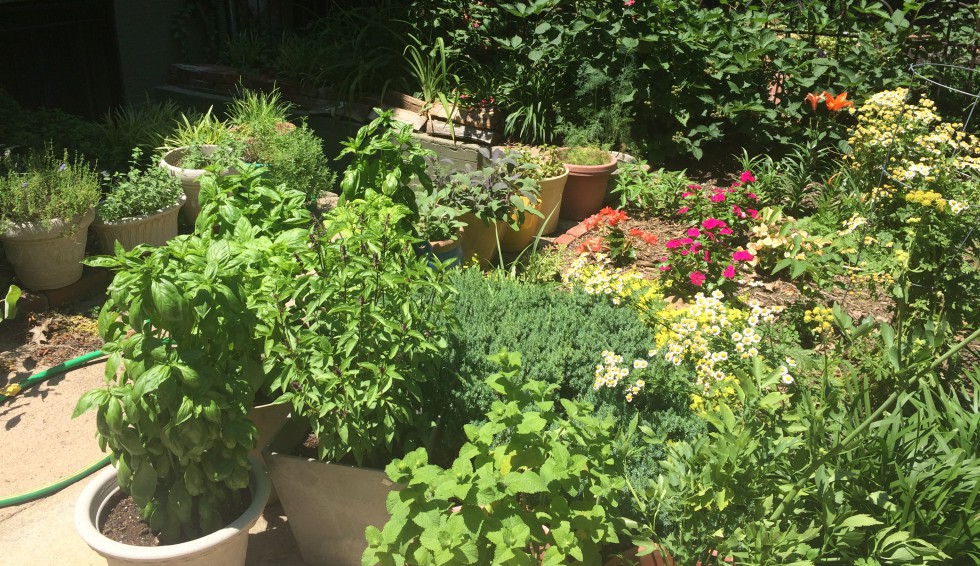
Recently, I have been doing a lot of thinking about the very interesting and complex issue of how where we live affects what we eat, and vice versa. This post simply relays my layperson’s thoughts on various aspects of this topic and does not purport to be a scholarly work. I nonetheless hope the post will be thought-provoking, and that you’ll include some of your observations in the comments.
Human Migrations Because of Migrating Food Sources
The topic of food as it relates to place captured my attention last week as I conversed with my friend Dennis Stanford. Dennis is an archaeologist at the Smithsonian’s Museum of Natural History who recently received a very prestigious award for a book called Across Atlantic Ice that he coauthored with Bruce Bradley of the University of Exeter. This book posits that the earliest inhabitants of North America were not, as most of us were taught in school, the people who came across the Bering land bridge from Siberia. Dennis and Bruce argue that, long before the Siberian migration, people came from the Solutrean region of France and Spain to what is now the east coast of the United States. They did this using boats to skirt the southern edge of the ice sheet that occupied the Atlantic Ocean during the last ice age. A primary reason for this transatlantic migration was that these early people were following abundant marine food sources that thrived along the ice’s edge while terrestrial food sources were much less plentiful.
As I talked to Dennis about his work, my first reaction was to wonder aloud how many other significant prehistoric migrations involved people following migratory sources of food. Dennis cited the Thule (pronounced “too-lee”) Migration of an Inuit population from the Bering Straits to arctic Canada and Greenland as another example. He also mentioned an Algonquin population that depended on migrating animals for food and accordingly moved themselves in semi-nomadic fashion. I suspect there are many other examples, particularly among prehistoric people who had not yet mastered agriculture and had to eat what they could find.
The Development of Agriculture, and Putting Down Roots
Next, my thoughts focused on the fact that there is food that moves and, thanks to the development of agriculture, there is food that stays put. By learning to grow their own crops and raise their own domesticated animals, our early ancestors eliminated one of the key reasons people previously were forced (or tempted) to pick up and go. As a result, early humans began to enjoy a more geographically stable existence, but to achieve this stability our forebears had to pay careful attention to where they situated themselves. It is no coincidence that major population centers typically occupy fertile soil near a fresh water source. Combine that with the development and advancement of irrigation, and people eventually could spread out farther from the water yet still remain stationary.
Agricultural Failures As a More Modern Reason for Migration
Stationary food sources are critically important and generally reliable, but they are not infallible. In fact they sometimes have failed in profoundly spectacular and painful ways. The Irish potato blight in the mid-1800’s, for example, was a major cause of the influx of Irish immigrants into the United States and other countries during that period. Although different in context from the prehistoric migrations that preceded it, this mass exodus from Ireland demonstrated the primal and eternal truth that people will go to whatever lengths are necessary to solve their food problems.
What Happens When People with Established Food Cultures Move Around?
Since the founding of the United States, various groups of people with well-established food cultures have migrated here, not all for reasons related to a food crisis. Regardless of their reasons for coming, their presence has had some interesting food-related consequences in their adopted land.
A friend at the dog park observed how immigrant groups often would gravitate toward places in the United States with climates similar to their homeland, which allowed them to grow familiar foods. As examples, she mentioned her hometown in Pennsylvania, which became home to Irish immigrants, and how people from Scandinavian countries gravitated toward Minnesota, Wisconsin, and other areas of the midwest. Through their strategic choice of location, immigrants thus brought aspects of their food growing culture with them.
Perhaps more obvious to an urban dweller, immigrant groups also brought their cooking and eating cultures and wove them into the fabric of American cuisine Some obvious examples are Little Italy in New York, Chinatown in San Francisco, and the Polish restaurant scene in Chicago. We also have immigrants to thank for numerous ethnic markets and stores. Two of my favorite DC examples are A. Litteri, which is an Italian store dating back to 1926, and Eden Center, which is a Northern Virginia strip mall that houses a plethora of Vietnamese shops and restaurants.
Another point worth considering is that, when multiple food cultures exist simultaneously in the same place over a long period, as has happened in some areas of the United States, they start to meld in interesting ways and further transform the overall food culture within which they exist. An example of this is “fusion” food that typically blends Asian cooking with something else. This has essentially become its own cuisine and is increasingly common in many major US cities.
The Modern Luxury of Being Able to Separate One’s Home from One’s Food Sources
One thing that is striking about the issue of food and location today is that, at least in the United States, where we live is not as inextricably linked to the acquisition of food as was previously the case, largely because of advances in agricultural and transportation techniques. Now, for example, people can live en masse in places like Phoenix, Arizona, where not much of the edible variety naturally grows. The obvious, and costly, tradeoff is that most of what sustains human life in such places must be transported from elsewhere. Barbara Kingsolver highlighted this issue in Animal, Vegetable, Miracle, in which she documented her family’s decision to move from Arizona to a farm in Virginia to grow their own food so they could reduce their food-related carbon footprint.
The Modern Luxury of Being Able to Grow One’s Own Food in New and Interesting Places
On the flip side, there are other, more positive examples of how food acquisition can transcend traditional geographical bounds, primarily because new innovations and attitudes have encouraged people to grow food in new and creative ways.
One of my favorite examples is that of Novella Carpenter, who in the book Farm City recounts how she transformed a vacant lot in a severely blighted part of Oakland, California, into a garden that supported vegetables, bees, poultry, rabbits, and pigs. Less extreme but in the same vein, there now are numerous community gardens in urban areas that allow apartment and townhouse dwellers to tend a plot within a nearby communal space. Some of these community gardens fortuitously are located near schools, which provides an excellent means to teach agricultural awareness to children who might not otherwise know how food grows. Other innovations include green roofs, vertical planters, and “edible walls,” which let people grow their own food without the need to find additional real estate, and in the last two cases potentially even without going outdoors.
What about the Future?
In the United States, I think the pendulum has swung about as far as it can in the direction of allowing people to live in a place that is disconnected from the source of their food. One thing that seems clear is that, with our changing environment, that pendulum eventually will swing back toward our basic need for food dictating where we live. Climate change, along with some of the less-conscientious agricultural practices that contribute to it, will slowly (or maybe not so slowly) transform land that today is fertile and productive into land that is no longer arable. Additionally, as the weather changes, places that once were ideal for growing food crops and raising animals will cease to be so, while other areas will become better suited to those purposes. As this happens, people will need to adapt, either by moving or by finding creative solutions that allow them to stay put.
In preparation for the day when this pendulum swings back, if for no other reason, I think the nexus between food and place is well worth pondering. Food for thought, as I have become fond of saying.
 Capitol Hill Cooks
thanks adrianne…. this has been great food for thought…. thinking about the local honey that is sold at the congressional cemetery and about the wonderful local food from the H street farmer’s market…. freddie’s honey crisp apples and applesauce from quaker valley farms, star thistle honey from up home…. Kipp’s fresh eggs, and my wonderful experiences working with Ritchfields farms…… And, Indian spices from Pansarri….17th and Q…. I think my favorite restaurant in DC is the cafateria at the Indian museum….. great indiginous cuisine. thanks all for supporting local farmers. I was thinking about our little patches of dirt here in the city and about Beauty Jackson farming the lot out back with greens of all kinds. On that snowy, MLK day, I dug into the snow and pulled out a handful of fresh rosemary for a North african stew I was making….
and, every day, the lavender bushes out front enliven my senses and make me happy.
LikeLike